KCGM Operations

-
 Adjacent to the City of Kalgoorlie-Boulder, 600km east of Perth, Western AustraliaLocation
-
 Open pit and undergroundMine type
-
 468kozF26 gold production
-
 1989Commenced gold production
-
 42,191kozMineral Resources at 31 March 2026
-
 14,997kozOre Reserves at 31 March 2026
-
 1,990Employees
-
 Residential & FIFOEmployment type
One of Australia’s largest open pit gold mines, KCGM Operations is a world class asset.
KCGM Operations include the Fimiston open pit (Super Pit), Fimiston and Mt Charlotte underground mines and the Fimiston and Gidji processing plants.
The Golden Mile at the centre of the Kalgoorlie Goldfield, is one of the richest gold deposits in the world, producing more than 65 million ounces of gold over 130 years.
Rich History
The 1893 gold rush resulted in the discovery of the Golden Mile, which by 1903 had 49 operating mines, 100 headframes and over 3,000km of underground workings.
In the 1980s, WA businessman Alan Bond began acquiring individual leases along the Golden Mile with the aim of consolidating them. While Bond’s company failed to complete the takeover, the leases were combined in 1989 and Kalgoorlie Consolidated Gold Mines Pty Ltd (KCGM) was formed to manage the KCGM Operations on behalf of the joint venture owners.
In 2019 and 2020, Saracen Mineral Holdings Ltd and Northern Star acquired the respective 50% interests in the KCGM Operations.
On 3 January 2020, KCGM Operations became 100% Australian-owned for the first time in its 31-year history.
When the merger between Northern Star and Saracen was implemented in February 2021, the KCGM Operations became controlled by a single entity, Northern Star, for the first time in its history.

The Kalgoorlie Goldfield is part of the Norseman-Wiluna greenstone belt, consisting of volcanic and sedimentary rocks, surrounded by extensive granite.
The deposit is comprised of a series of mineralised faults which are known as lodes and mainly occur in a host rock known as the Golden Mile Dolerite.
More than 1,000 individual ore lodes occur within the Golden Mile, some extending up to 1,800m long, 1,200m deep and 10m wide.
Mining at KCGM Operations
Mining the Super Pit is a carefully planned sequence involving cooperation across a wide range of departments and specialist teams. Each has their part to play, from geology, environment, mine planning and survey teams to drillers, blasting engineers and the giant shovels and haul trucks which transport ore for processing and waste for disposal.
Open pit mining is completed by our mining operations team with total mine movements of over 80Mtpa completed by a modern truck and shovel mining fleet.
At the Mt Charlotte Underground, our mining services division Northern Star Mining Services (NSMS) is responsible for mining over 2Mtpa from the large mining complex through a series of long hole open stoping and sub level caving production areas.
Northern Star are also actively developing the Fimiston Underground advancing the underground growth targets alongside and below the Super Pit. NSMS provides underground mining services at Fimiston, with multiple mining areas being progressively developed as the operation continues to grow.

The Fimiston processing plant currently treats ore from Fimiston and Mt Charlotte.
In June 2023, Northern Star approved an expansion to increase the mill capacity from 13Mtpa to 27Mtpa by FY29 (including a 2-year ramp up), becoming one of the largest milling complexes in Australia.
In August 2026, commissioning of the expanded Fimiston processing plant commenced, representing a major milestone in the project.
The Super Pit Lookout
The most popular tourist attraction in Kalgoorlie-Boulder, the Super Pit Lookout draws thousands of locals and tourists each year with many visiting from interstate and overseas.
The unique opportunity to view a working mine site in action, and the chance of watching a blast in real time, make the lookout a must do while in Kalgoorlie-Boulder.
The Super Pit Lookout is open 7am-7pm daily, subject to operational requirements, with the access road off Mount Monger Road (off the Goldfields Highway).
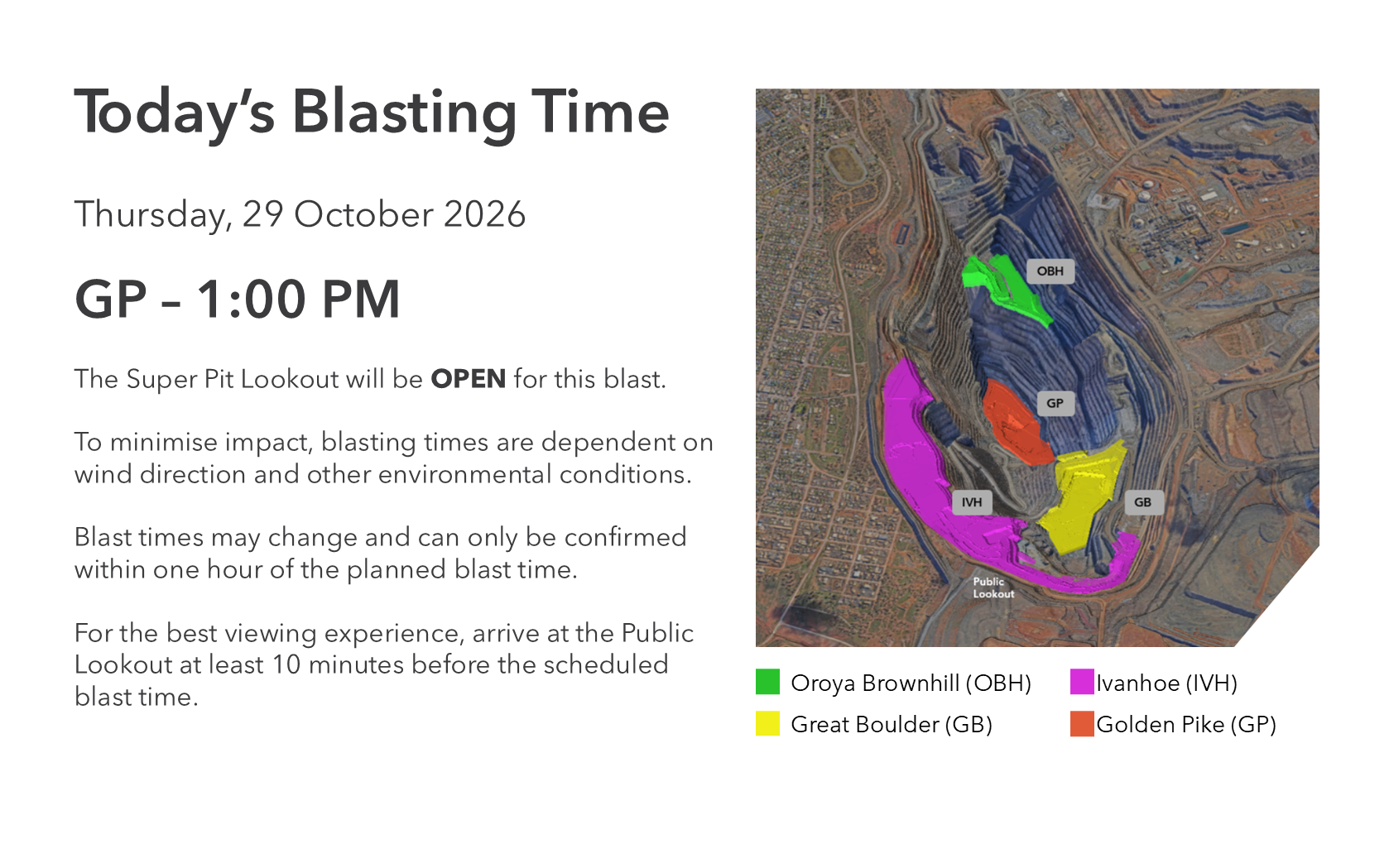
Northern Star invites the public into our KCGM Operations to experience a behind the scenes look at the gold mining process.
Local tour provider, Kalgoorlie Tours & Charters operates a tour, inclusive of a private internal viewing platform, commentary from a local tour guide and a close-up view of the mining operation and the significant expansion projects that are currently underway.
For more information visit kalgoorlietours.com.au
After visiting our KCGM Operations, a visit to Hannans North Tourist Mine completes the experience with more than 30 exhibits on show in Kalgoorlie’s largest open-air museum.
Step back in time on a self-guided tour, see historical buildings from the 1920s, experience gold fever in the panning ponds, then relish in modern day mining equipment as you climb aboard a 793C haul truck and 994 wheel loader.
For more information visit hannansnorth.com.au
Our ongoing growth projects are supporting long-term, sustainable operations, while creating lasting opportunities for both our Kalgoorlie Production Centre and the Kalgoorlie-Boulder community.
Discover more | Let's Grow Together
Check out our quarterly community newsletters below or visit our Community & Indigenous Engagement page to discover more about our approach.
- Community Newsletter Vol 1 (Nov 2025)
- Community Newsletter Vol 2 (Feb 2026)
- Community Newsletter Vol 3 (May 2026)
- Community Newsletter Vol 4 (Aug 2026)
Discover more | Community & Indigenous Engagement
The Northern Star Public Interaction Line is for community stakeholders to formally raise a concern about the Kalgoorlie Production Centre.
The Public Interaction Line is accessible 24 hours a day, seven days a week. Once a concern is received by a Northern Star employee via the PIL, the Community team coordinates the required action and provides follow up.
Northern Star Public Interaction Line (PIL): +61 8 9022 1100

Environmental impacts are monitored and managed across the KCGM Operations with annual Compliance Assessment Reports, published online.
They confirm whether every environmental condition has been complied with, show monitoring results, explains any exceedances or non-compliances and describes corrective and preventative actions taken.
The Fimiston Air Quality Management Plan (FAQMP) was initially developed by KCGM in 2007 to integrate a number of management plans that cover various air quality aspects of the Fimiston Operations, including the Dust Monitoring and Management Programme. It was reviewed and approved by the EPA in 2026.
Major sources of dust emissions include drilling and blasting; loading and unloading of ore and waste rock; vehicle-generated dust; wind erosion; crushing; and conveying.
Continuous dust monitoring occurs at the Hannan’s Golf Course (HGC), Boulder Shire Yard (BSY), Hewitt Street (HEW), Clancy Street (CLY), Hopkins Street (HOP), Mt Charlotte (MTC) and Metals Exploration Yard (MEX) sites.
The HGC site is primarily used as a control/background monitoring site for dust, located some 4.5 km from the Fimiston Operations and considered to be representative of the local environment enabling comparison.
The 24-hour average PM10 concentrations measured at each site are contained in the KCGM Dust Monitoring Report, publicly available online within 24-hours of the data being recorded.
KCGM Operations have undertaken several measures to reduce dust emissions and to ensure the 24-hour average PM10 concentrations are less than the limits imposed by Ministerial Statement 1258.
These measures include wind and weather monitoring, the use of water trucks, delaying or suspending activities in unfavourable conditions, visual inspections, progressive rehabilitation to minimise exposed area, and dust concentrations monitors with a control system with trigger and action response levels dependent on dust concentration criteria at each monitoring station.
KCGM-Dust-Monitoring-network
KCGM Dust Report (24-hour averages for 1-month)
Noise
The Fimiston Open Pit (Super Pit) operates 24 hours a day, seven days a week. The main sources of noise are haul trucks, reversing alarms, track noise from dozers, excavators, shovels, blasting, noise from material handling (e.g. loading ore and waste rock into trucks) and conveyors.
The KCGM Fimiston Noise and Vibration Management Plan (NVMP) was developed to minimise the potential impacts of mining operations on the Kalgoorlie-Boulder community. Included in the NVMP is the KCGM environmental noise bund, built to reduce noise from the operation entering town. The noise bund now extends for a total distance of five kilometres along the western edge of the Fimiston open pit.
Compliance noise monitoring is conducted at five reference locations, Boulder Primary School (BPS), Baron Street Williamstown (BSW), Kalgoorlie Technical School (KTS), York Street Boulder (YSB) and Outram Street Boulder (OSB). Continuous noise monitoring is conducted at MEP and at BPS. A real-time noise monitor is installed on Holmes Street, Kalgoorlie (MEP). The report from this location is updated every 15 minutes and is available for public viewing. KCGM quarterly compliance noise monitoring results are available in the KCGM Resource Library below.
Real-Time Noise Monitoring Report
KCGM Noise Monitoring Network
Blasting
KCGM Operations’ proximity to the community, coupled with mining amongst historical workings, has shaped the blasting methods used. Blasting at KCGM Operations is carefully managed to minimise potential impacts on the residents of Kalgoorlie-Boulder.
The vibrations generated vary depending on the type of blasting performed, which is determined by factors such as location, ore body and presence of historical workings or other geological structures.
Blasting is limited to 7am to 6pm and is avoided on Sundays, where possible. Vibration limits are in place and Airblast noise levels must comply with WA noise regulations. Monitoring results and compliance reporting is published online, along with updated noise and vibration plans available on the website.
Effective management of water and tailings is crucial to KCGM Operations, as both are critical components in the processing of ore into gold.
Water is required for many activities including dust control, mineral processing, transporting tailings and for site amenities. Most of the water used at KCGM Operations is saline groundwater and recycled water, however, some potable (drinking) water is also required for operations.
The KCGM Operations must manage water and tailings in line with approved environmental management plans, monitor performance against licence conditions and environmental limits, and report monitoring results and any issues in annual environmental reports.
“Tailings” is the term used to describe the waste product from processing plants and is typically a slurry mixture of finely ground solids, process water and residual reagents.
Tailings storage facilities (TSFs) are fully fenced and are designed by specialist engineers to withstand floods, earthquakes and erosion. Tailings volumes deposited to the TSFs are directly related to tonnages of ore or concentrate treated at the processing plant.
The tailings are pumped to the TSF, the solids settle and the water is recycled for reuse in the processing plants. KCGM Operations has a Water Efficiency Management Plan which is aligned with the Water Corporation’s Waterwise Business Program, aimed at minimising potable water use.
KCGM Fimiston Seepage and Groundwater Management Plan
KCGM Kaltails Seepage and Groundwater Management Plan
Northern Star is committed to ensuring effective management and protection of biodiversity at the KCGM Operations. This includes undertaking baseline studies as well as ongoing botanical and wildlife surveys to understand the biodiversity values in the area.
The team take great care to ensure the safe, humane capture and removal of native animals from its operations. Disturbance Permit Forms are an internal process used to manage clearing of native vegetation on site. Management plans are also implemented to aid in protecting rare or endangered species.
Programs across site are also implemented to increase control of feral, pest and weed species, including regular department and contractor inspections, as well as ad hoc removal initiatives where necessary.
Post-mine life is considered while mining is ongoing with a plan for rehabilitation and mine closure in place. A Mine Closure Plan must be submitted to regulators in the required reporting years and are prepared in line with the DMIRS Mine Closure Guidelines (2021). This plan is updated and resubmitted when required. Progressive rehabilitation is carried out where possible and progress is reported in annual environmental reports.
KCGM MCP 2025 v2 Vol 1
KCGM MCP 2025 v2 Vol 2
KCGM MCP 2025 v2 Vol 3 Appendix App 1 to 3
KCGM MCP 2025 v2 Vol 3 Appendix App 5 to 7
KCGM Resource Library
Below are documents related to our KCGM Operations
Ministerial Reports
- Fimiston Gold Mine Compliance Assessment Report 2025
- Gidji Gold Processing Plant Compliance Assessment Report 2025
- MS782 5 Year Performance Review 2020-2024
Management Plans
- Fimiston Noise and Vibration Management Plan February 2026
- Ministerial Statement 1258 – Compliance Assessment Plan 2026
- Fimiston Air Quality Management Plan 2026
- KCGM Fimiston Seepage and Groundwater Management Plan 2025
- KCGM Kaltails Seepage and Groundwater Management Plan 2025
- Significant Species Management Plan Fauna 2026
- Significant Species Management Plan Flora 2026
Mine Closure Plans
- KCGM MCP 2025 v2 Vol 1
- KCGM MCP 2025 v2 Vol 2
- KCGM MCP 2025 v2 Vol 3 Appendix App 1 to 3
- KCGM MCP 2025 v2 Vol 3 Appendix App 5 to 7
Noise Regulations
-
Gidji Gold Processing Plant Compliance Assessment Report 2024
-
Gidji Gold Processing Plant Compliance Assessment Report 2023
-
Gidji Gold Processing Plant Compliance Assessment Report 2022
-
Gidji Gold Processing Plant Compliance Assessment Report 2021
-
Gidji Gold Processing Plant Compliance Assessment Report 2020
-
Gidji Gold Processing Plant Compliance Assessment Report 2019
-
Gidji Gold Processing Plant Compliance Assessment Report 2018
-
Gidji Gold Processing Plant Compliance Assessment Report 2016
-
Fimiston Annual Audit Compliance Report 1st January to 31st December 2015